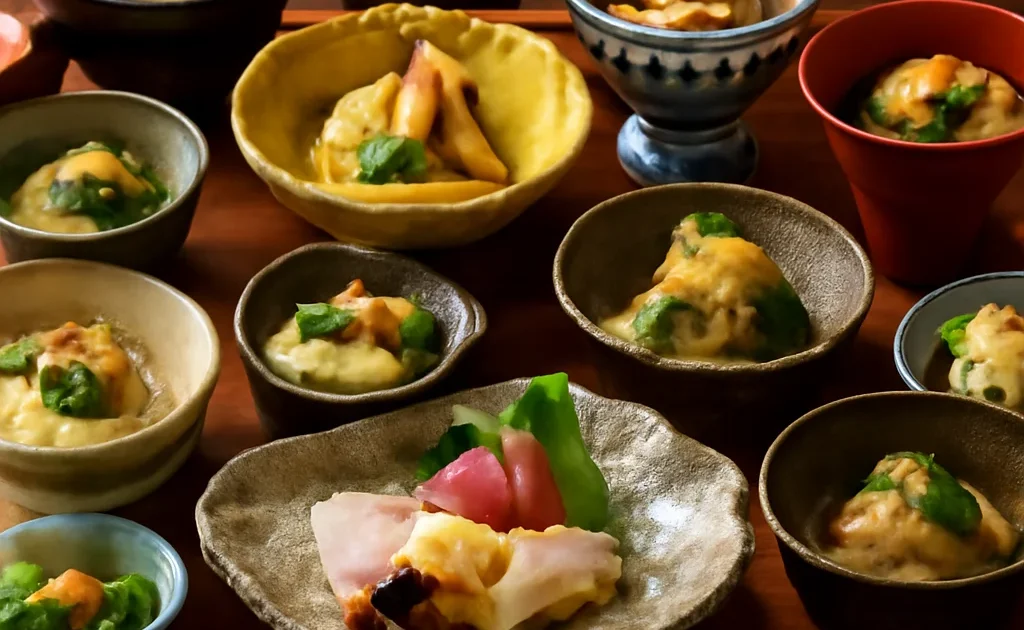
Japan’s Regional Food Culture
Japan is not one food culture — it’s dozens. Each region has dishes that are taken very seriously locally and rarely found elsewhere.
Tokyo Food
Tokyo’s signature styles are refined versions of national classics.
Must eat in Tokyo:
- Shoyu ramen (soy sauce-based — the original Tokyo style)
- Monjayaki (Tokyo’s answer to okonomiyaki — messier, more liquid)
- Edomae sushi (the traditional Tokyo sushi style — fish aged slightly before serving)
- Yakitori in Yurakucho or Shinjuku
- Tsukiji Outer Market breakfast (the best morning food experience in Japan)
Kyoto Food (Kyo-ryori)
Refined, delicate, vegetable-focused. Kyoto’s cuisine evolved from Buddhist temple cooking and centuries of imperial court influence.
Must eat in Kyoto:
- Kaiseki (multi-course seasonal cuisine — the pinnacle of Japanese cooking)
- Tofu dishes (yudofu, agedashi tofu — Kyoto tofu is Japan’s finest)
- Obanzai (traditional home cooking — small plates of pickled and simmered vegetables)
- Matcha sweets (from Uji tea region)
- Kyo-tsukemono (Kyoto pickles — extraordinary variety)
Osaka Food
Osaka’s food culture is guided by the principle of kuidaore — eat until you drop. Flavors are bolder and portions are more generous than Kyoto.
Must eat in Osaka:
- Takoyaki (octopus balls — this is their birthplace)
- Okonomiyaki Osaka-style
- Kushikatsu (Shinsekai neighborhood)
- Kani (crab — Osaka is crab central)
- Horumon (offal yakitori — beloved local specialty)
Hokkaido Food
Japan’s northernmost main island has its own distinct food culture, shaped by dairy farming and cold-water seafood.
Must eat in Hokkaido:
- Sapporo Miso Ramen (rich miso broth with corn and butter)
- Jingisukan (grilled lamb on a domed iron plate)
- Seafood: crab (kani), sea urchin (uni), scallops, salmon
- Dairy products (soft serve ice cream is exceptional)
- Soup Curry (Sapporo’s signature dish)
Hiroshima Food
Must eat in Hiroshima:
- Hiroshima-style okonomiyaki (layered, not mixed — completely different from Osaka style)
- Oysters (kaki — Hiroshima produces 60% of Japan’s oysters)
- Tsukemen (cold dipping ramen)
—
Essential Japanese Dishes: The Full List
Noodles
Ramen: Pork or chicken broth with wheat noodles. Styles: shoyu (soy), miso, tonkotsu (pork bone), shio (salt).
Udon: Thick wheat noodles in clear dashi broth. Filling and comforting.
Soba: Buckwheat noodles, served hot or cold with dipping sauce.
Tsukemen: Cold noodles dipped in concentrated hot broth.
Yakisoba: Stir-fried wheat noodles. Festival and street food staple.
Rice Dishes
Donburi: Rice bowl with toppings. Types: gyudon (beef), oyakodon (chicken and egg), katsudon (pork cutlet and egg), unadon (eel).
Onigiri: Rice ball wrapped in nori. Filled with salmon, tuna mayo, pickled plum, or other fillings. Convenience store staple.
Karaage-don: Fried chicken rice bowl.
Grilled and Fried
Yakitori: Grilled chicken skewers on bamboo sticks.
Kushikatsu: Deep-fried skewers of meat, seafood, vegetables.
Tonkatsu: Breaded, deep-fried pork cutlet.
Karaage: Japanese fried chicken.
Tempura: Lightly battered and fried seafood and vegetables.
Kara-age: Marinated deep-fried chicken (different from tempura batter).
Street Food
Takoyaki: Octopus balls from round-celled iron plates.
Okonomiyaki: Savory pancake with cabbage and toppings.
Taiyaki: Fish-shaped cake filled with sweet red bean or custard.
Crepes: Tokyo Harajuku-style crepes with elaborate fillings.
Sushi and Seafood
Nigiri sushi: Hand-pressed rice with fish on top.
Maki sushi: Rolled sushi in nori.
Temaki: Hand-rolled cone sushi.
Sashimi: Raw fish without rice.
Kaiten-zushi: Conveyor belt sushi.
Omakase: Chef’s choice tasting menu (high-end).
—
How to Eat at Japanese Restaurants
Ticket vending machine (jidou hanbaiki): Many casual restaurants use a machine at the entrance. Insert cash, press the button for your dish, hand the ticket to staff when seated.
Oshibori: Small towel for wiping hands, provided at every sit-down restaurant. Use only for hands, not face.
Water: Usually free, poured automatically. Other drinks are ordered.
Slurping: For noodles, slurping is expected and considered complimentary. Don’t be self-conscious about it.
No tipping: Ever. Not in any circumstances.
“Irasshaimase!”: Staff shout this when you enter. You don’t need to respond.
Refills: Water and sometimes tea are free. Most other drinks are not.
—
Japan Food Budget
| Meal Type | Cost |
|---|---|
| Convenience store meal | ¥300–600 |
| Standing noodle bar | ¥450–750 |
| Gyudon chain | ¥500–700 |
| Ramen restaurant | ¥750–1,300 |
| Lunch set (teishoku) | ¥900–1,600 |
| Mid-range dinner | ¥2,000–5,000 |
| High-end dinner | ¥10,000–30,000 |
| Omakase sushi | ¥20,000–80,000+ |
—
Tsukiji market tours, ramen-making classes, sake brewery visits and Osaka street food tours all available through Klook. Book ahead for weekend dates.
Book Japan food tours & cooking classes on Klook →
* Affiliate link — we may earn a small commission at no extra cost to you.
Related Guides
Plan Your Trip
- 🎫 Tours & activities — KKday
- 🏨 Hotels — EconomyBookings
- 🚕 Airport transfer — Welcome Pickups
- 📱 eSIM & SIM card — Airalo
- 🚗 Car & scooter rental — Localrent
- ✈️ Flights — Kiwi.com