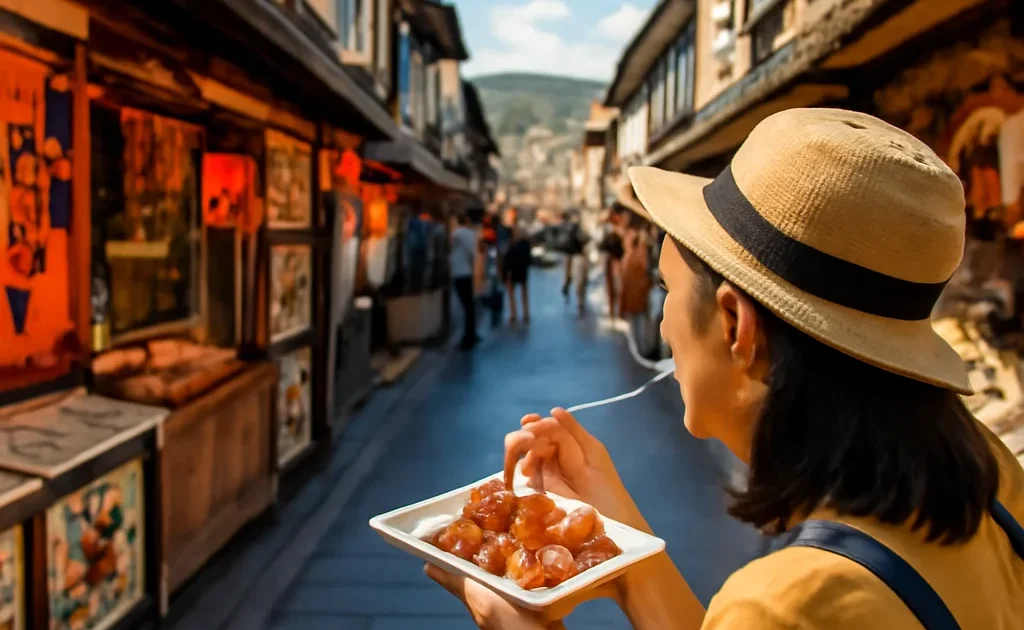
There’s a phrase Osaka people use about themselves: kuidaore. It roughly translates to “eat yourself bankrupt.” The first time someone explained it to me over a shared plate of takoyaki outside Dotonbori, I laughed. By the end of that trip, I completely understood.
Osaka is the city where I’ve eaten more, eaten better, and eaten more recklessly than anywhere else in Asia. It has ruined me for street food everywhere. Here’s what you need to know.
The Street You Can’t Skip
Dotonbori is the obvious starting point, and yes, it’s touristy, and yes, it’s worth it. The canal, the giant mechanical crab rotating above Kani Doraku, the smell of grilling meat and sweet sauce rolling off every other doorway — it hits you all at once and it’s genuinely exciting. I walked out of the subway station on my first Osaka evening and stood still for a full minute just taking it in.
The takoyaki here is the real deal: octopus balls fried in cast iron moulds, topped with bonito flakes that dance from the heat, drizzled with mayo and Worcestershire-based sauce. Eat them fresh, burn your tongue a little, order another batch. Crispier on the outside than you expect, molten in the center. I didn’t know they were this good until I had them in Osaka. The ones I’d eaten at food courts in other countries were a completely different food.
But Dotonbori gets crowded and loud fast. For a more local takoyaki experience, walk fifteen minutes to Namba or Shinsaibashi and find a smaller stand where a grandmother is operating a battered iron plate and a small crowd of locals is waiting. That’s where I’ve had my best ones.
Okonomiyaki: The One You Need a Table For
Okonomiyaki is Osaka’s other great invention — a savoury pancake of cabbage, pork belly, egg, and whatever else the cook feels like adding, all grilled on a flat iron and buried under more of that extraordinary sauce. It’s the kind of food that doesn’t photograph particularly well and tastes absolutely extraordinary.
The best okonomiyaki experience is at a restaurant with a grill built into the table, where the cook brings out the raw mixture and you watch it being prepared in front of you. Some places let you cook it yourself, which is fun if you’re with people and disastrous if you don’t know what you’re doing — I once managed to burn the outside while leaving the inside raw on my first attempt. The cook politely took over.
Kushikatsu: The Rules Matter
Kushikatsu — skewered and deep-fried vegetables, meat, and seafood — comes with the most important rule in Osaka food culture: do not double-dip the communal sauce. There are signs about it everywhere. The restaurants really mean it. I watched a tourist dip twice once and the table went visibly quiet. The sauce is excellent and it would be a shame to miss it because you broke the rule.
Order widely and in no particular order. The pork, the lotus root, the corn, the whole boiled quail egg — all of them work. The sauce is thick and slightly tangy. The crunch when you bite through the breadcrumb crust is deeply satisfying. Have a cold beer. Sit at the counter so you can watch the cooks work.
The Morning Osaka Nobody Talks About
Every Osaka food guide sends you to Dotonbori at night. My honest recommendation is to set an alarm and go at 7am. The canal is quiet, the lights are still on but the crowds are gone, and the fish shops and produce sellers are setting up around the Kuromon Ichiba market nearby. Kuromon is Osaka’s kitchen market — two long covered arcades of fishmongers, butchers, pickle sellers, and produce stalls that open early.
I’ve had some of my best Osaka eating at 8am: fresh uni on a tiny piece of rice handed over a counter by a fishmonger who doesn’t need to speak English because the food explains itself, a scallop grilled on its shell right in front of me, a wedge of tamagoyaki (rolled omelette) still warm from the pan. The whole thing costs almost nothing. Nobody is photographing it. That’s the Osaka I come back for.
What Gets Overhyped
I’ll be honest: I’ve never fully understood the Ichiran ramen phenomenon. The individual booths, the privacy screens, the intense focus — it’s an experience, and I get why people like it. But the ramen itself has never been the best bowl I’ve had in Japan. It feels more like a concept than a meal. If it’s your first time, try it for the experience. But there are better ramen in Osaka in smaller, less famous shops.
Also: the Glico running man sign is fun to see once for about thirty seconds. It is not a destination.
A Note on Eating Cheap
Osaka is already one of the more affordable food cities in Japan, but the move for budget travelers is standing restaurants. Tachigui (standing) udon and soba shops are everywhere, fast, and cost ¥400–600 for a bowl. There’s one near every major train station. I’ve had excellent udon in fluorescent-lit standing bars next to salarymen eating in under five minutes, and I’ve loved every second of it.
The tip that matters most: come hungry, come often, and when you find something that’s good, go back the next day. Osaka is a city that rewards loyalty and repetition more than sightseeing.
Plan Your Trip
- 🎫 Tours & activities — Klook
- 🏨 Hotels — EconomyBookings
- 🚕 Airport transfer — Welcome Pickups
- 📱 eSIM & SIM card — Airalo
- 🚗 Car & scooter rental — Localrent
- ✈️ Flights — Kiwi.com