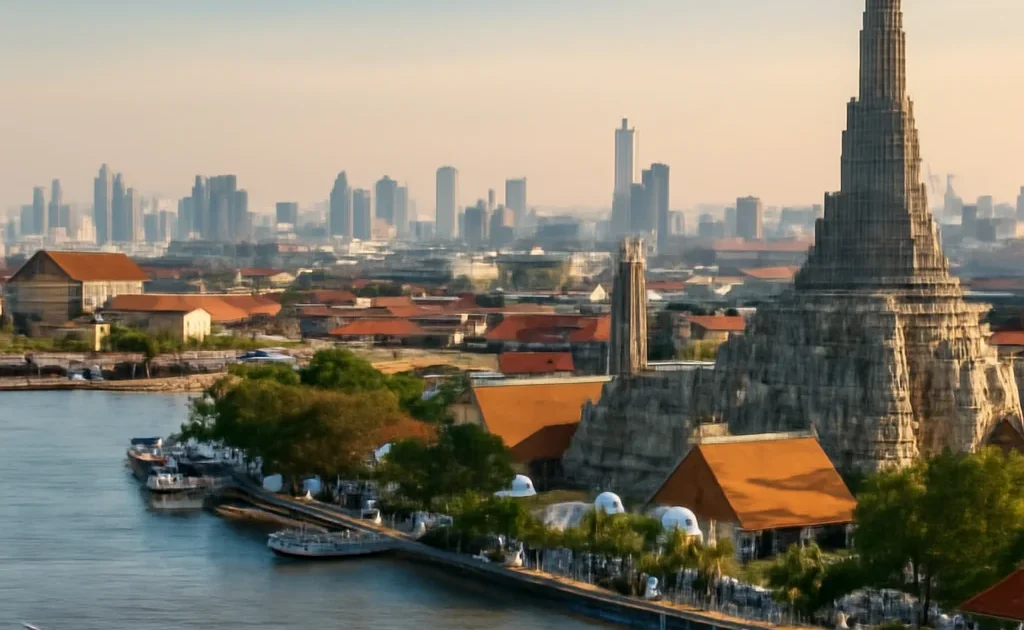
I’ve had a complicated relationship with Bangkok for years. The first time I arrived — sweaty, jet-lagged, dropped into the chaos of Khao San Road by a cab driver who clearly knew exactly what he was doing to me — I thought I hated it. Too hot. Too loud. Too much of everything at once. I left after four days and felt relieved.
Then I came back eighteen months later and stayed for three weeks. Now it’s one of my favorite cities on earth. The difference was not Bangkok. It was me finally understanding how to be there.
The Heat Is Real and You Should Take It Seriously
Bangkok sits close to the equator and the heat is not decorative. In the hot season (March to May), it regularly hits 38°C with humidity that makes it feel like you’re walking through warm soup. I saw a tourist visibly wilt outside the Grand Palace once — he’d come straight from the airport without stopping to change out of his jeans, walked an hour in the sun, and simply sat down on a stone step and couldn’t get up.
— book via Welcome Pickups airport transfer for the best deal.
The move is simple: be outside before 10am and after 4pm, stay in air conditioning during the middle of the day, and drink water constantly. The Thai iced tea (cha yen) sold everywhere for about ¥30 baht is cold, sweet, slightly milky, and perfect. Buy one constantly.
The rainy season (June through October) brings daily downpours — heavy, dramatic, usually over within an hour — and drops the temperature slightly. It’s not a bad time to visit if you’re prepared for wet afternoons.
Getting Around Without Losing Your Mind
I didn’t know on my first trip that the BTS Skytrain and the MRT subway together don’t actually cover most of Bangkok. They cover the modern, tourist-friendly areas. The neighborhoods worth exploring — the old city around the Chao Phraya river, Chinatown, the flower and amulet markets — require other methods.
The river is the answer. The Chao Phraya Express Boat is genuinely one of the great urban transport experiences in Southeast Asia: a long wooden boat thumping through the brown water, workers and monks and market vendors and tourists all packed together, pulling up to rickety wooden piers with about 30 seconds to jump off before it moves again. It’s cheap, useful, and gives you a view of Bangkok you can’t get from a tuk-tuk.
Speaking of tuk-tuks: they’re fun once, for a short distance, in a non-rush-hour situation, when you’ve already agreed the price before getting in. They’re not the practical daily transport some guidebooks imply. Grab (the Thai equivalent of Uber) is cheap, air-conditioned, and stress-free. I use Grab for most things now.
The Temples
The Grand Palace and Wat Phra Kaew are non-negotiable. Yes, they’re on every tourist itinerary. Yes, they’re crowded. They are also genuinely astonishing — the gold tiles, the towering prangs, the murals covering every surface of the covered galleries, the smell of incense and flowers and the sound of monks chanting somewhere deeper inside. I’ve been three times and I’m still not done looking.
Dress modestly: covered shoulders, long pants or skirt, no open-toed shoes that can’t be removed easily. You’ll be turned away or rented a cover-up at the gate if you’re not dressed appropriately, which feels embarrassing and is easily avoided.
Wat Pho — the reclining Buddha temple just outside the Palace walls — is my personal favorite. The Buddha is 46 meters long and covered in gold leaf, and the expression on its enormous face is unexpectedly serene and almost amused. The complex also houses one of Bangkok’s oldest massage schools. Getting a traditional Thai massage in the actual Wat Pho school — a back-and-forth dialogue of pressure and stretch, conducted in near silence on a thin mat — is one of the more memorable body experiences I’ve had anywhere.
What I Got Wrong the First Time
I made the classic Bangkok mistake of basing myself on Khao San Road, the famous backpacker strip. It’s not a bad base logistically, but it exists in its own bubble — full of other travelers having roughly the same experience, surrounded by Thai people whose job is to service tourists. I felt like I was in Bangkok but somehow not in Bangkok.
My second trip I stayed near Ari, a neighborhood in the north of the city where expats and young Thai professionals live, full of coffee shops and small restaurants and absolutely nobody selling banana pancakes. The Bangkok I found there — quiet sois (small streets) with spirit houses outside every building, local lunch spots where I pointed at things and hoped for the best, a neighborhood park where elderly men fed the cats at dawn — was the city I’d been looking for.
The Food Situation
The street food is not overhyped. A pad kra pao (Thai basil pork with a fried egg over rice) from a cart on a random street corner — the wok smoking, the basil going in at the last second, the chili heat arriving a beat after the first bite — costs about 50 baht and will make you question every restaurant you’ve eaten in before. Eat it at a plastic table on the pavement with a fork and spoon. Order it again for breakfast.
My honest tip: get out of the tourist areas at least one evening. Take Grab to a neighborhood you’ve never heard of, find a local market or night food street, point at something that smells good, and just eat. Bangkok’s best food is not in restaurants. It’s on a cart, in a styrofoam box, eaten standing up. Chase that.