I resisted Bali for years. It felt too popular, too curated, too full of people doing yoga in expensive white linen. Then a friend dragged me there almost against my will, and within 48 hours I understood completely why everyone keeps going back.
Bali is not one place. It’s a collection of distinct, genuinely different worlds packed into a small island, and which one you end up in depends entirely on the decisions you make in the first 24 hours after landing.
The Arrival Choice That Changes Everything
Ngurah Rai airport sits in the south of the island, and most tourists head straight to the nearby beaches of Kuta, Seminyak, or Canggu — the strip of coastline that has become Bali’s party and digital nomad zone. There is nothing wrong with these places. Seminyak has excellent restaurants and beautiful sunsets. Canggu has good surf and the best coffee I’ve found anywhere in Southeast Asia. But they are also, increasingly, places where you could go a full week without interacting meaningfully with Bali itself.
The other choice is Ubud, 40 minutes inland in the center of the island. Rice terraces, temples, traditional dance, rainforest. It’s more touristy than it sounds from that description — the main street is full of galleries and wellness retreat shops — but even now, step five minutes off the main road and you’re walking past paddy fields with nothing but the sound of frogs and a distant gamelan rehearsal somewhere in the trees.
I always spend my first few days in Ubud. It calibrates you correctly.
What I Didn’t Expect
I didn’t know how deeply religious Balinese daily life is until I watched a family lay out a small offering of flowers and rice and incense on the pavement outside their door one morning — not a special occasion, just a Tuesday. These offerings (canang sari) appear everywhere, every day: outside shops, on dashboards, at the base of temple gates. The smell of incense is constant and oddly calming.
I stepped on one by accident on my first day and was mortified. Nobody was angry — a local woman just smiled and redirected me around it — but I became much more careful after that. Watch where you walk, especially in the mornings when fresh ones have just been placed.
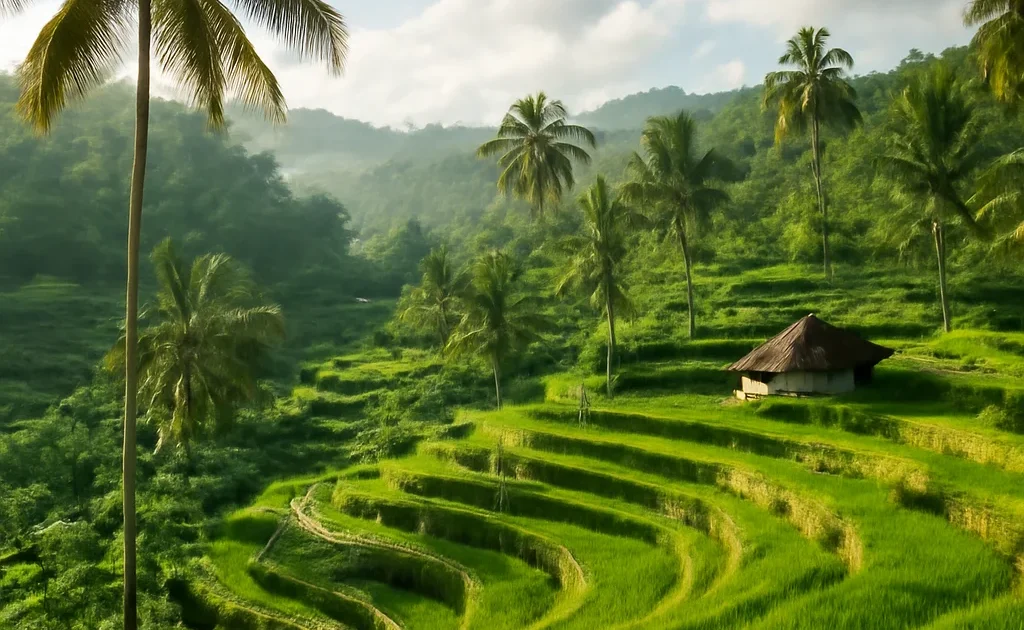
The other thing I didn’t expect: the island is not flat. Driving between Ubud and the coast involves a genuinely mountainous landscape — deep valleys, volcano views if the clouds clear, rice terraces that seem to go on forever. Renting a scooter or hiring a driver for a day of countryside exploring is one of the best things you can do in Bali. The roads are chaotic but navigable if you’re comfortable on two wheels.
— book via Kiwi.com for the best deal.
Ubud: The Real Deal and the Tourist Trap
Tegalalang Rice Terrace is beautiful. It’s also, these days, ringed with cafes selling coffee for 150,000 rupiah (about $10) where the main product is a good backdrop for photos. If you want to see genuine working rice terraces without the Instagram scaffolding, walk out of Ubud toward Campuhan Ridge or head north toward Jatiluwih, a UNESCO-listed terrace landscape that sees a fraction of the visitors.
The Sacred Monkey Forest is genuinely fun once and completely exhausting by the end. The monkeys are clever and aggressive and will steal anything that isn’t secured. I lost a hair tie, a lens cap, and most of my dignity to a particularly confident macaque in about forty minutes. Hold your belongings tightly, don’t smile at them (shows teeth, which they read as aggression), and watch out for babies clinging to their mothers — the mothers get protective.
Temples and How to Visit Them
You’ll need a sarong to enter any Bali temple, and you’ll be renting one at the gate if you don’t bring one. Just bring one — a lightweight one costs almost nothing at any market and saves time and money.
Tanah Lot is the famous sea temple photographed from every angle at sunset, and it’s worth seeing once despite the crowds. Besakih, the “Mother Temple” on the slopes of Mount Agung, is a much more impressive and much less-visited complex — vast, layered, atmospheric, and requiring about half a day if you want to do it properly.
The temple ceremony I stumbled into in a small village outside Ubud — invited in by a family who saw me watching from outside the gate, given a sarong and a place to sit, offered coffee — is the memory I carry above all the famous sites. I didn’t understand the ceremony. It didn’t matter. The gamelan music was complex and hypnotic, the incense thick, the priest’s movements precise and unhurried.
What Guidebooks Get Wrong
Everyone tells you Bali is cheap. It can be, but the version of Bali marketed to most Western travelers — the nice villas, the wellness retreats, the hip restaurants in Canggu — is not cheap. A single night in a well-reviewed villa can cost the same as two weeks of budget travel elsewhere in Southeast Asia.
The genuinely cheap Bali exists in local warungs (family-run restaurants) where a full nasi campur (rice with small portions of various dishes) costs 20,000–30,000 rupiah ($1.50–2), in street food, in rental scooters, in staying slightly away from the main tourist centers. Set a daily budget and commit to eating local at least twice a day. Your money goes dramatically further.
The tip I give everyone: spend at least one night somewhere other than the south coast and Ubud. Drive up to Munduk in the highlands, or over to Amed on the east coast. The Bali most people show in photos is real and beautiful. The Bali that most people miss — quieter, cooler, less performed — is even better.
Plan Your Trip
- 🎫 Tours & activities — Klook
- 🏨 Hotels — EconomyBookings
- 🚕 Airport transfer — Welcome Pickups
- 📱 eSIM & SIM card — Airalo
- 🚗 Car & scooter rental — Localrent