Introduction
Asia offers the world’s most photogenic travel experiences — ancient temples at golden hour, rice terrace landscapes, floating markets at dawn, neon-lit city streets. This guide covers the best photography spots by country with timing advice.
—
Japan Photography
Fushimi Inari (Kyoto): The thousands-of-torii-gates shot. 6am to avoid crowds. Look for the sections where the gates are most dense and the light filters through.
Arashiyama Bamboo (Kyoto): 6–7am for atmospheric light and no people. Vertical composition works best.
Mount Fuji reflections (Kawaguchiko): Early morning for still water. November–January for snow on the summit.
Shibuya Crossing at night: Best from above — Scramble Square Shibuya Sky observation deck, or the Starbucks window on the corner.
Cherry blossoms: Golden hour, overcast days for soft light, rain for petals on stone paths.
—
Thailand Photography
Wat Arun (Bangkok): From the east bank at dusk when the temple glows orange. The cross-river ferry perspective.
Phi Phi Islands: From speedboat or kayak at water level — the limestone cliffs are most dramatic from the water.
Chiang Mai temples: Dawn. Doi Suthep at sunrise before the crowds.
Floating market (Bangkok area): Early morning from a long-tail boat — sellers and produce reflected in water.
—
Bali Photography
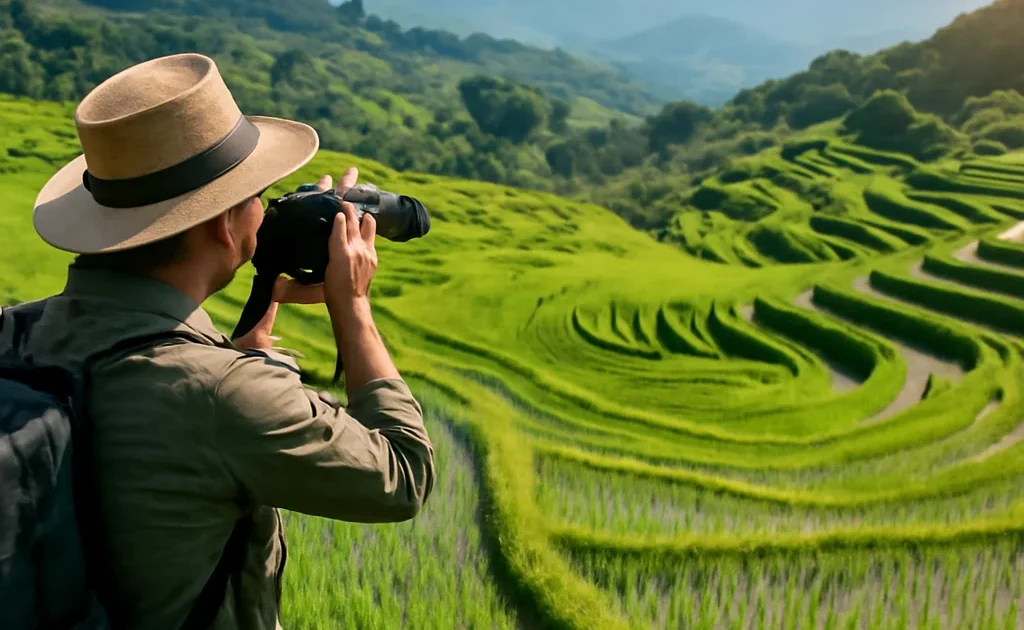
Tegallalang Rice Terraces: Dawn. Shoot from the hillside looking into the terraces.
Tanah Lot: Sunset. Use a rock just south of the temple for a reflection shot.
Bali swing (Ubud area): Popular but requires booking. Golden hour light.
Uluwatu cliff bars: Looking back at the temple cliff from Single Fin bar.
—
Vietnam Photography
Ha Long Bay: The classic shot requires positioning away from the other tour boats. Ask your cruise boat to stop in an area with clear sight lines.
Hoi An lanterns at night: Full moon night. Position near the Thu Bon River with lanterns reflected in the water.
Rice terraces (Sapa): September–October for harvest season gold. Dawn light.
Mekong Delta: Pre-dawn from a small boat at Cai Rang floating market — sellers’ faces lit by lanterns.
—
Camera Gear Tips
Lens: A 24–70mm covers most travel situations. A 70–200mm is useful for portraits and compressing temple shots. A wide 16–24mm for interior temple architecture.
Filters: ND filters for waterfall long exposures. CPL for reducing reflections on water.
Golden hour: Asia’s light is harsh midday in tropical countries. Dawn and the hour before sunset are the best light windows everywhere.
Monochrome: Japan’s temple architecture often works beautifully in black and white.
—
Sunrise photography tours at Angkor Wat, Fushimi Inari dawn walks and Hoi An lantern festival experiences are bookable on Klook.
Plan Your Trip
- 🎫 Tours & activities — KKday
- 🏨 Hotels — EconomyBookings
- 🚕 Airport transfer — Welcome Pickups
- 📱 eSIM & SIM card — Airalo
- 🚗 Car & scooter rental — Localrent
- ✈️ Flights — Kiwi.com