I’ve heard people say Angkor Wat didn’t live up to the hype. Every single time, the explanation is the same: they did it in a day, they arrived at the main temple at 9am with every other tourist, and they left exhausted and vaguely disappointed.
Angkor doesn’t work that way. It’s not a single thing you visit. It’s a landscape — hundreds of temples spread across 400 square kilometers of jungle — and it needs time, early mornings, and at least one moment alone with something ancient and extraordinary. Get those things right and it will be among the most powerful experiences of your life.
How Many Days You Actually Need
The standard Angkor itinerary is two days. The honest answer is three, and four is better if you’re genuinely interested in archaeology or photography.
The Angkor Archaeological Park pass comes in one-day, three-day, and seven-day versions. The three-day pass doesn’t have to be consecutive, which is worth knowing. Day one for the main circuit, day two for the outlying temples, day three for whatever you missed and want to return to.
I spent four days on my first visit and still didn’t see everything I’d wanted to. I’ve been back once since and still haven’t covered it all. This is not a complaint.
Angkor Wat Itself
The main temple — Angkor Wat, the largest religious monument on earth — is what everyone comes for, and it earns the pilgrimage. Walking toward it for the first time across the long causeway over the moat, the five towers rising in the heat haze, is genuinely one of those travel moments that stops your internal monologue.
The sunrise at Angkor Wat is the experience recommended by every guide, and it’s beautiful — the towers reflecting in the lotus pond in front, the light changing from purple to orange to gold. It’s also attended by an enormous crowd. I was there at 5:15am on a weekday and found hundreds of people already in position. The view is still extraordinary; just manage your expectations for solitude.
What I didn’t expect: the interior bas-reliefs. The carved stone galleries running around the inner walls depict entire mythological narratives — the Churning of the Ocean of Milk, scenes from the Mahabharata — in extraordinary detail, hundreds of figures across hundreds of meters of stone. A good guide is essential here. Without someone explaining what you’re looking at, the carvings are beautiful but confusing. With explanation, they become gripping.
Bayon: The Face Temple
Ta Prohm — the “jungle temple” where the tree roots swallow the stones — gets all the photographic attention. It deserves it. But my favorite temple in the complex is Bayon, at the center of Angkor Thom, and I don’t hear enough people say this.
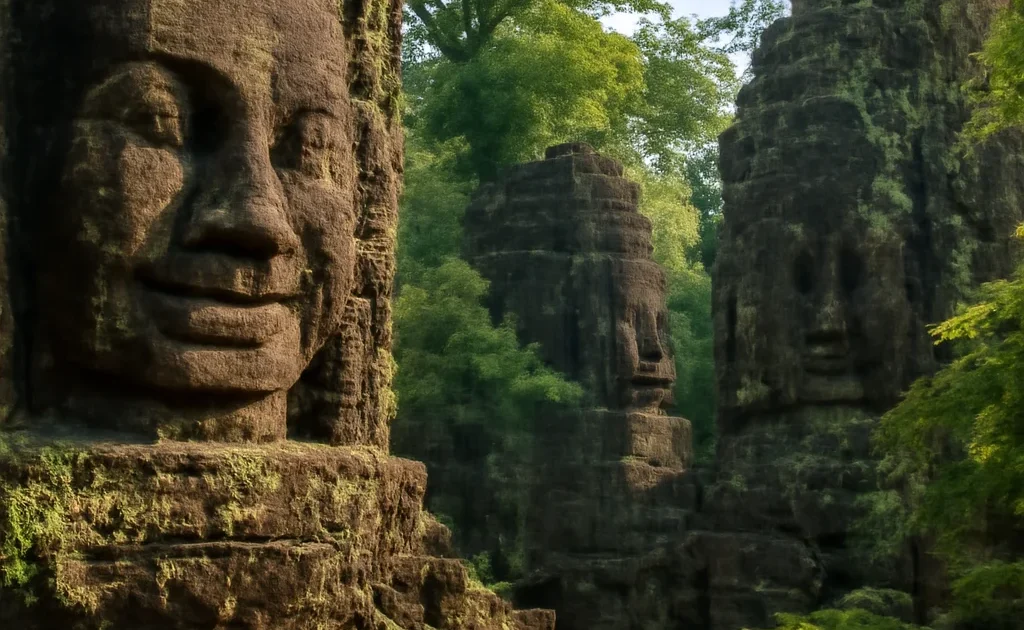
Bayon is a mountain of stone towers, each one carved with enormous serene faces — 216 faces in total, looking outward in every direction, slightly smiling. Walking through it in the early morning mist, turning a corner and coming face-to-face with a three-meter stone expression gazing past you into the middle distance — it’s uncanny and beautiful and completely unlike anything else.
Get there before 8am. The light comes through the stones differently then, and the faces emerge from the mist slowly, one by one, as you walk deeper in.
Ta Prohm: Managing the Famous Moment
Ta Prohm is the temple that appeared in Tomb Raider, and it looks exactly as incredible in person as it does in photos — silk-cotton trees with roots pouring over walls and through doorways, stone and root intertwined in a way that looks deliberate, like the forest decided to finish what the builders started.
The problem is the crowd and the photography queue. There are two or three spots at Ta Prohm that everyone photographs, and there are often 20 people waiting for their shot at each one. My solution: arrive at opening (7:30am), walk past the famous spots quickly, explore the less-photographed back sections of the temple (genuinely beautiful and rarely crowded), and come back to the famous spots at the end when the early crowd has moved on.
I Got the Transport Wrong
I hired a tuk-tuk on my first day in Siem Reap and paid a fixed rate for the day. This was fine. What I should have done: hire the same driver for all four days. By day two, a good Angkor tuk-tuk driver knows where you want to go before you’ve said it, knows which temple has an unusual crowd that morning and suggests an alternative, knows the chai and fresh coconut sellers parked in the shade at the right distances. My driver Mr. Dara became the best part of the trip. He waited patiently, pointed out details I’d walked past, and suggested a detour to a completely empty 11th-century temple on my last afternoon that I’d never have found alone.
Ask around in Siem Reap for driver recommendations, find someone you like, and stick with them.
What Guidebooks Get Wrong
They suggest the Angkor Wat sunrise but don’t tell you to visit again in late afternoon, when the tour buses are gone, the light turns golden on the stone, and you can sit on the causeway almost alone. That second visit — quieter, slower, the towers darkening against the dusk sky — was better than the sunrise.
The tip that matters most: bring more water than you think you need, start every morning before 7am, and let at least one afternoon be completely unplanned. The temples you stumble across by wandering, without a map or a must-see list, are often the ones you remember longest.
Plan Your Trip
- 🎫 Tours & activities — Klook
- 🏨 Hotels — EconomyBookings
- 🚕 Airport transfer — Welcome Pickups
- 📱 eSIM & SIM card — Airalo
- 🚗 Car & scooter rental — Localrent
- ✈️ Flights — Kiwi.com