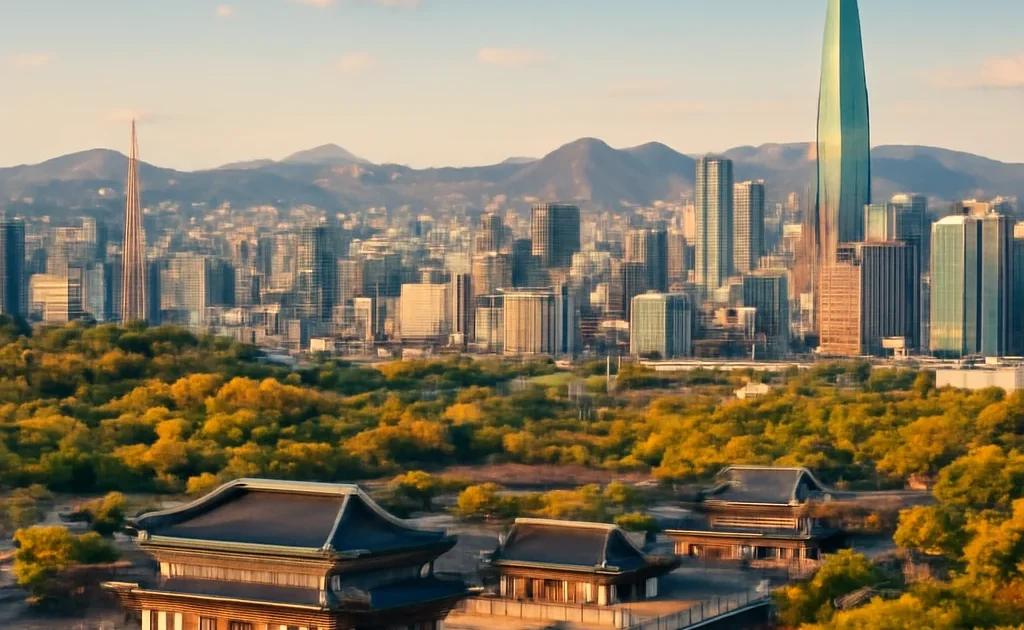
I went to Seoul expecting to like it and came back completely in love with it. That gap — between what I anticipated and what I found — is the most accurate measure I have of how good a city actually is. Seoul exceeded everything.
It’s a city that contains contradictions so comfortably it makes them feel natural: ancient palaces next to glass towers, Buddhist temples between luxury shopping malls, pojangmacha street food stalls in the shadow of Michelin-starred restaurants. I spent ten days there and only started to understand it by day six.
Getting In and Getting Around
Incheon International Airport is consistently rated one of the best airports in the world, and it earns that reputation — clean, efficient, easy to navigate, and connected to the city by a fast express train (AREX) that deposits you at Seoul Station in 43 minutes. Buy a T-money card at the airport before anything else: it works on every subway, bus, and many taxis in the city, and topping it up is as easy as handing notes to a cashier at any convenience store.
The Seoul Metro is excellent. Fast, clean, air-conditioned to the point of being cold in summer, with multilingual signage and announcements. Every line has a different color. You will figure it out within two trips. I was navigating confidently by day two, which never happens to me in a new Asian city that fast.
The Palaces and What They Mean
Seoul has five grand Joseon-era palaces, and most tourists see Gyeongbokgung — the largest, most famous, most photographed — and stop there. It’s absolutely worth visiting: the throne hall (Geunjeongjeon) with its elaborate roof lines and the mountains rising behind it is genuinely powerful, and the hourly changing of the guard ceremony is theatrical and precise.
But my favorite is Changdeokgung, and specifically its Secret Garden (Huwon) — a 78-acre woodland of ponds, pavilions, and forested paths that was used as the private retreat of the royal family. Entry to the Secret Garden requires a guided tour, which you book in advance, and the groups are kept small. Walking through ancient Korean forest in near-silence with a knowledgeable guide, stopping at a lotus pond where the reflection of a wooden pavilion shimmers in still water — it felt like the kind of place that shouldn’t exist in the middle of a city of ten million people.
I didn’t know about this garden on my first trip. That’s honestly the thing I’m most annoyed about.
Food, Which Is Really the Point
Korean food is one of the great cuisines of the world and it’s almost impossible to eat badly in Seoul. The barbecue (KBBQ) is the famous experience — meat grilled at the table, wrapped in lettuce with garlic and ssamjang paste — and it deserves every bit of its reputation. The key things I’ve learned: go for the samgyeopsal (thick pork belly) or the galbi (short ribs), order the doenjang jjigae (fermented soybean stew) on the side, and let the server help you with the grill. They will come and cut the meat without being asked. It’s not condescension; it’s service.
But the food I love most in Seoul is cheaper and less choreographed. Tteokbokki — chewy rice cakes in a fiery red pepper sauce — from a street vendor at 10pm, eaten from a paper cup with a wooden toothpick, the heat building slowly until my nose is running and I’m pointing at the vendor for more. Japchae, the glass noodle dish, appearing unexpectedly in a set lunch and being better than I expected. Sundubu jjigae (soft tofu stew) at a tiny restaurant near Insadong, red and bubbling and arriving with eight small side dishes (banchan) that I kept eating even after I was full.
A Mistake Worth Making
I made the mistake of going to Hongdae on a Saturday night early in my first trip — Hongdae is Seoul’s main nightlife and university district, all neon and K-pop blasting from every shop front and enormous queues for clubs. It was overwhelming in a way I wasn’t ready for. I left after an hour feeling like I’d experienced something I wasn’t the audience for.
What I should have done first: Insadong for its antique shops and tea houses, Bukchon Hanok Village for the traditional Korean houses on the hillside above the city, Ikseon-dong for its narrow alleys of cafes and small restaurants in old Korean buildings. These are the Seoul that got under my skin. Hongdae I understood better later, when I knew the city well enough to pace myself.
What Guidebooks Get Wrong
Everyone says Seoul is expensive because of KBBQ restaurants and the fancy neighborhoods. It can be. But there’s a very affordable Seoul running parallel to it: the gimbap restaurants where lunch costs ₩5,000-7,000 (under $5), the pojangmacha (street tent restaurants) with plastic chairs and excellent fried snacks and cold beer, the food courts in subway stations that serve full meals for almost nothing.
I ate extremely well in Seoul for about $15-20 a day on food alone. That’s not difficult if you eat where locals eat.
The tip that changes the trip: go to a jjimjilbang (Korean bathhouse and sauna) at least once, ideally overnight. They’re open 24 hours. You pay a flat entry fee (around ₩10,000-15,000), get a locker, shorts and a t-shirt, and access to hot baths, saunas, heated floor rooms, a common area with snacks, and the option to just sleep on the floor overnight. It’s one of the more culturally specific and genuinely wonderful experiences in Asia, and most tourists miss it entirely.
Plan Your Trip
- 🎫 Tours & activities — Klook
- 🏨 Hotels — EconomyBookings
- 🚕 Airport transfer — Welcome Pickups
- 📱 eSIM & SIM card — Airalo
- 🚗 Car & scooter rental — Localrent
- ✈️ Flights — Kiwi.com