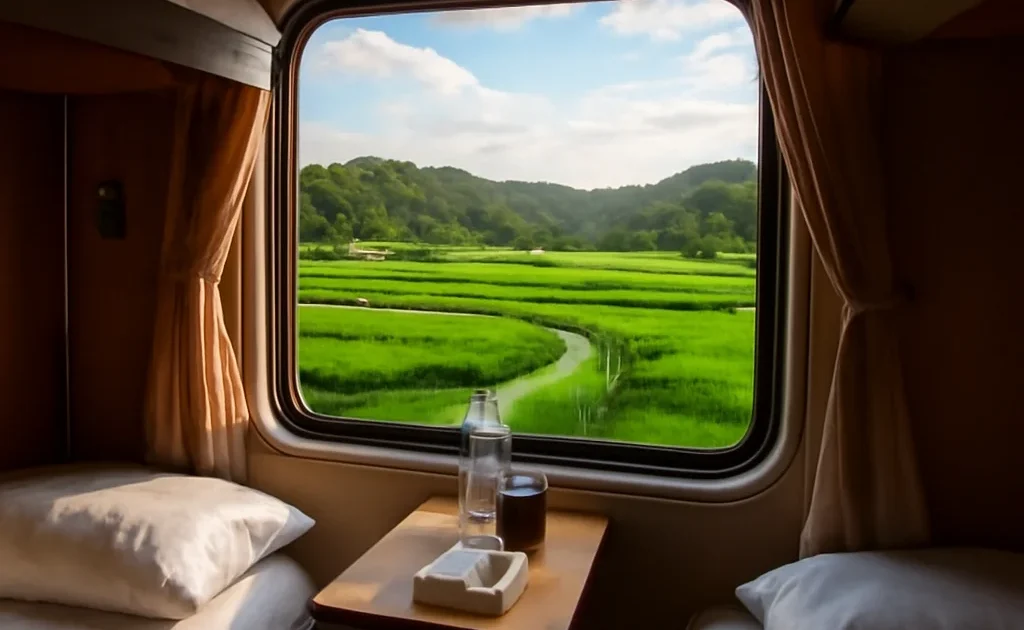
The Reunification Express
Vietnam’s main railway runs the length of the country on what’s still sometimes called the Reunification Express — the line that reconnected north and south after 1975. Traveling it overnight is one of those genuinely good travel experiences that doesn’t need romanticizing, though it’s easy to romanticize anyway: countryside at dusk, dinner in the dining car, watching the coastal landscapes give way to rice paddies as you head north.
The train vs bus comparison
For the key overnight routes (Hanoi–Hue, Hanoi–Da Nang, HCMC–Nha Trang), the train is generally more comfortable than a sleeper bus — wider berths, more stable, actual dining car, and the scenery is better. It’s usually slightly more expensive but worth the difference. The Hanoi to Hue route specifically, crossing the Hai Van Pass at dawn, is one of Vietnam’s great train journeys.
Classes and what they mean
Hard seat (ghế cứng): actual seats, no sleeping for overnight. Fine for short day journeys.
Soft seat (ghế mềm): padded, still seats, not ideal overnight.
Hard sleeper (giường nằm cứng): 6-berth open compartments, basic mattresses. Cheap, fine, quite social.
Soft sleeper (giường nằm mềm): 4-berth closed compartment, better mattresses, air conditioning. My default. Around 450,000–700,000 VND for major routes.
Booking
The Vietnam Railway website (dsvn.vn) has English options and works well now. Klook and 12Go Asia also handle bookings with good interfaces. Book at least a week ahead for popular routes in peak season — soft sleeper berths sell out.
Plan Your Trip
- 🎫 Tours & activities — KKday
- 🏨 Hotels — EconomyBookings
- 🚕 Airport transfer — Welcome Pickups
- 📱 eSIM & SIM card — Airalo
- 🚗 Car & scooter rental — Localrent
- ✈️ Flights — Kiwi.com