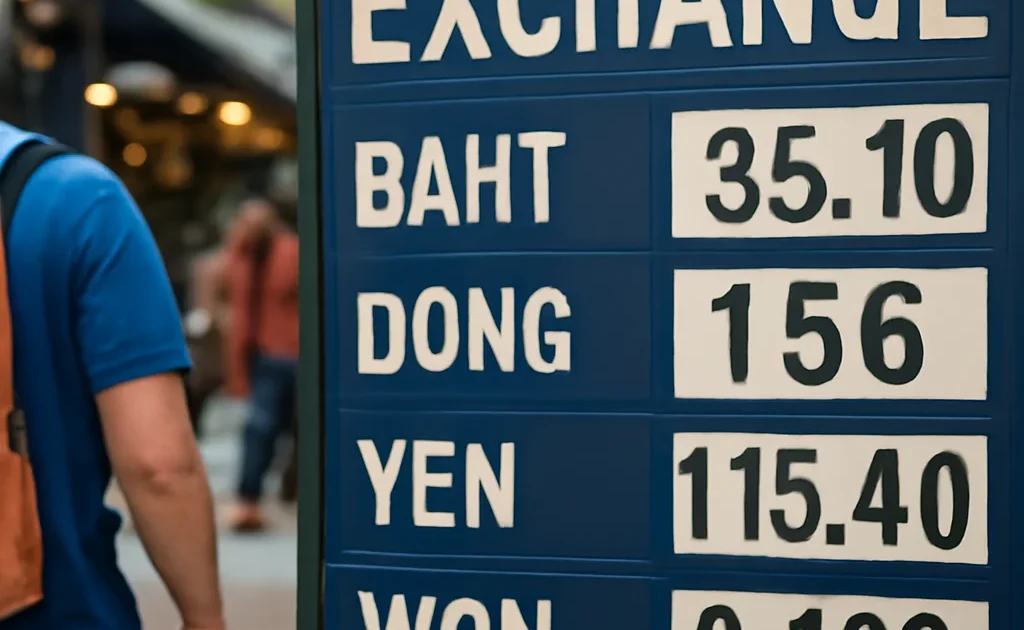
The rate difference is real and adds up
A 3% spread on currency exchange sounds small until you’re exchanging $3,000 over a two-month Asia trip — that’s $90 in fees you could have avoided. Here’s how to keep exchange costs minimal.
ATMs: the default for most countries
In Thailand, Vietnam, and Indonesia, withdrawing local currency from ATMs with a fee-free card (see below) gives better rates than most exchange desks. In Japan, 7-Eleven ATMs accept almost all international cards with no machine fee. In Singapore, DBS and OCBC ATMs have good rates.
ATM fees to watch: the local bank’s fixed fee (THB 200–220 in Thailand, VND 66,000 in Vietnam) and your home bank’s foreign transaction fee. These add up — minimize withdrawal frequency by taking larger amounts less often.
The best card for Asia travel
A card with no foreign transaction fee and ATM fee reimbursement. Charles Schwab (US), Starling (UK), and Wise are popular options. Wise specifically is useful for pre-loading multiple currencies at near-interbank rates — I use it for Japan where I prefer having yen in hand rather than relying on ATMs.
Money changers
Sometimes better than ATMs for large amounts. In Bali, PT Dirgahayu gives the best exchange rates I’ve found. In Bangkok, SuperRich (orange or green branches) consistently beats airport and hotel rates. In Japan, post office ATMs and 7-Eleven ATMs are usually better than street-level exchange booths.
Never exchange at
Airport exchange counters (5–8% below interbank rate). Hotel front desks. Suspicious-looking “money changers” who count cash too quickly.
Plan Your Trip
- 🎫 Tours & activities — Klook
- 🏨 Hotels — EconomyBookings
- 🚕 Airport transfer — Welcome Pickups
- 📱 eSIM & SIM card — Airalo
- 🚗 Car & scooter rental — Localrent
- ✈️ Flights — Kiwi.com