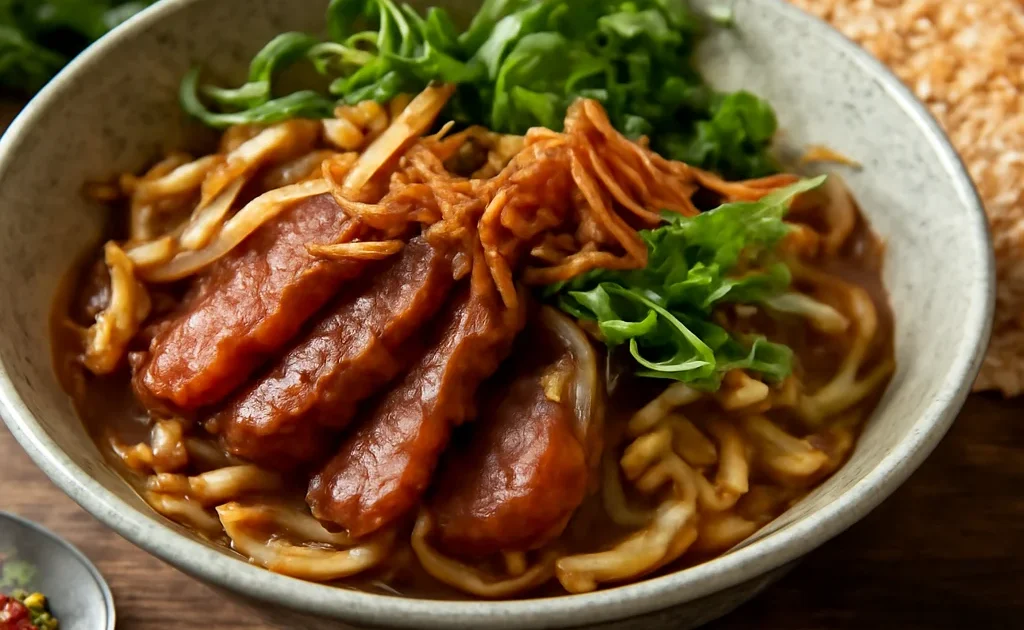
Why it only tastes right in this city
Cao lau is the most intriguing regional dish in Vietnam for a simple reason: it’s famously made with water drawn from specific local wells in Hoi An, and the noodles are ash-washed in a way that gives them a specific chewy texture and earthy flavor that can’t be replicated elsewhere. Whether this well-water claim is entirely true or partly legend doesn’t matter — cao lau does taste different in Hoi An than the approximations you find elsewhere.
What it is
Thick, flat noodles (similar in texture to Japanese udon but with a distinctive grey-brown color from ash) in a small amount of broth — more like a dressed noodle than a soup. Topped with slices of char siu-style roast pork, fresh bean sprouts and herbs, crispy rice paper crackers, and a few drops of thick soy-based sauce. The combination of textures is the point: chewy noodles, crackling crispy rice paper, tender pork, fresh herbs.
Where to eat it
The covered market in the center of Hoi An’s Ancient Town has multiple cao lau vendors — this is where locals eat it rather than at tourist restaurants. 60,000–80,000 VND per bowl. Arrive by 9–10am when the market is most active and the food is freshest.
Cao Lau Thanh on Tran Phu Street is the most famous dedicated vendor and consistently recommended. No English menu needed — point at the bowl in front of you.
The companion dishes
White Rose (banh vac) — steamed translucent rice dumplings shaped like white roses, filled with shrimp — is the other Hoi An specialty worth seeking out. Often sold at the same stalls as cao lau. 30,000–50,000 VND. The combination of cao lau and white rose as a morning market breakfast is one of Vietnam’s best food experiences.
Plan Your Trip
- 🎫 Tours & activities — Klook
- 🏨 Hotels — EconomyBookings
- 🚕 Airport transfer — Welcome Pickups
- 📱 eSIM & SIM card — Airalo
- 🚗 Car & scooter rental — Localrent
- ✈️ Flights — Kiwi.com